
Contact plates
Copper components manufactured to drawing for industrial systems.
View product →Mechanical components
Drawing-based components that transfer and distribute clamping force to contact shoes in electric furnace electrode systems.
Itametais manufactures individual segments, complete rings and preassembled sets in copper or bronze, with internal cooling circuits and capacity for parts weighing up to 1,500 kg, subject to technical feasibility assessment.
 01 / 20
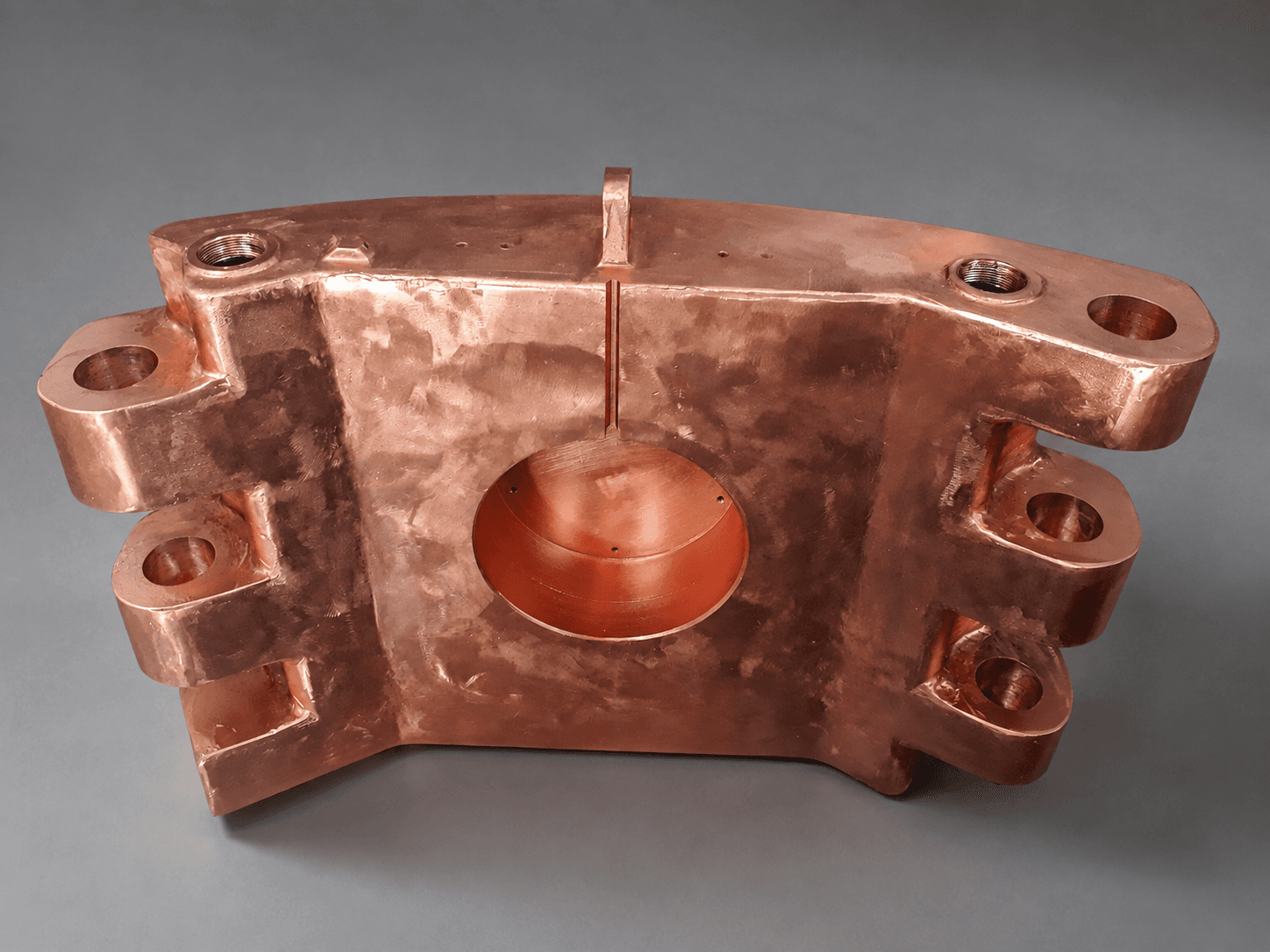
The pressure ring is part of the lower electrode-column assembly in certain electric furnaces. Installed around the contact-shoe assembly, it transfers and distributes the force required to press the shoes against the electrode or its metal casing.
In a typical sequence, the hydraulic, pneumatic or mechanical system actuates the pressure elements; force reaches the ring segments; the ring distributes it; and the contact shoes establish the electrical interface with the electrode. The exact arrangement depends on the furnace manufacturer and design.
The ring does not replace the contact shoes or carry the entire current by itself. Assembly performance depends on the integration of the mechanical, electrical, thermal and insulation components specified for the equipment.
The scope may include individual or replacement pressure-ring segments, complete rings, preassembled sets and special geometries manufactured to drawing or developed from a sample.
Segment count, split and geometry are not fixed. They depend on electrode diameter, number of contact shoes, pressure system, column design, mounting interfaces and maintenance requirements.
Rings and segments may be manufactured from copper, copper alloys, bronze or bronze alloys specified for the project. Material selection considers thermal exposure, mechanical strength, thermal and, where applicable, electrical conductivity, as well as manufacturing route, cooling, weldability, geometry, environment and equipment requirements.
Bolts, pins, bars, plugs, fittings and other auxiliary elements may use different materials when shown on the drawing. Composition, properties and standard equivalences must be defined in the contracted specification.
The manufacturing route is selected according to material, geometry, mass, dimensions, cooling circuit, tolerances, quantity, inspection requirements and operating conditions. No single process is presented as universally preferable.
A pressure ring may comprise multiple segments arranged around the contact shoes. These segments can include interfaces for pressure bellows, holes, flanges, pins, joining bars, slots, fits, lifting points, supports, fasteners, machined surfaces and cooling connections.
Geometric matching between segments supports assembly, concentricity, force distribution, compatibility with shoes and bellows, and maintenance access. Results must be verified against the tolerances and method defined for the project.
Pressure rings can be developed to work with hydraulic bellows, pneumatic bellows, mechanical actuators or other systems defined by the original design. Electrode columns do not all use the same actuation principle.
Depending on the contracted scope, Itametais can supply bellows, bellow interfaces, actuation elements, fasteners and associated pressure-system components in accordance with the drawing and limits set by the equipment manufacturer or customer.
Water-cooled pressure-ring segments may contain drilled or machined cooling passages, embedded tubes, welded closures and plugs, water inlets and outlets, flanges, fittings, hoses, piping and independent circuits distributed to the project design.
The circuit may be developed or reproduced from a drawing, sample or mapping of an existing component. Assessment considers specified flow rate, pressure and water temperature, pressure loss, thermal exposure, weld location and maintenance needs. Cooling manages thermal load within the design conditions; it does not remove the need for inspection and leakage control.
Work may include drawing-based manufacturing, development from a sample, reverse engineering, dimensional survey, interface verification, structural assessment, thermal and computational fluid-dynamics simulation, and cooling-circuit evaluation.
Channel mapping or resizing, weld and assembly analysis, redesign, improvement of existing designs and trial assembly may also be included. Every change is subject to technical assessment and customer approval.
Itametais has manufacturing capacity for parts weighing up to 1,500 kg. This limit applies to the part being assessed and does not mean that every complete pressure ring or assembled set has that weight.
Feasibility is assessed according to material, geometry, dimensions, process, machining and project requirements.
More than 400 parts have been supplied for industrial applications, manufactured from drawings, samples and requirements specific to electrode systems.
This history covers different components and scopes; it is not a count of complete pressure rings or a performance guarantee.
Used rings and segments can be assessed for recovery. The service may include initial inspection, disassembly, cleaning, dimensional survey, welding, dimensional restoration, machining, channel cleaning or unblocking, replacement of plugs, fittings or segments, circuit repair, reassembly, trial assembly and final testing.
Recoverability depends on component condition and technical assessment. Parts without a safe or economically sound repair route may require replacement.
According to applicability, project specification and contracted requirements, the inspection plan may include:
Controls are selected for each supply; this list does not imply that every test is mandatory for every part.
Failure analysis must consider the pressure ring within the electrode system. A furnace symptom cannot automatically be attributed to this component.
Subject to equipment architecture, rings can be developed for electrode systems in submerged arc reduction furnaces, ferroalloy furnaces, electric arc furnaces and installations with Söderberg electrodes, operating with alternating or direct current.
Application depends on the drawing and electrode-column architecture. Not every furnace uses a pressure ring, and one design does not automatically suit different equipment.
Assessment may cover steelmaking, metallurgy, ferroalloys and reduction or melting processes in electric furnaces, including ferrosilicon, ferromanganese, ferrochrome, ferronickel and silicon-metal production.
Each process requires verification of the equipment’s thermal, electrical, mechanical and cooling conditions.
When correctly specified, the ring can help distribute clamping force, maintain compatibility with the contact shoes, support dimensional stability and cool regions exposed to heat.
Drawing-based manufacturing also allows adaptation to the original system, segment replacement, maintainability where provided by the design, component recovery, trial assembly and dimensional control. Results depend on operating conditions and technical assessment.
Continue exploring
Copper components manufactured to drawing for industrial systems.
View product →Assemblies manufactured to the supplied configuration and design.
View product →Non-ferrous components developed for critical industrial applications.
View product →A sound development process begins before casting. Learn which information helps turn an operating requirement into a well-defined component.
Read article →Technical assessment
Send the drawing, sample and data for the furnace, electrode, contact shoes, segments, actuation, materials, interfaces, cooling circuit, tolerances, tests and failure history. Our team can assess the assembly and the appropriate scope.