Copper braids
Assemblies manufactured to the supplied configuration and design.
View product →Electrical and thermal conduction
Efficient current transfer, controlled cooling and dimensional accuracy for electrode systems in critical industrial applications.
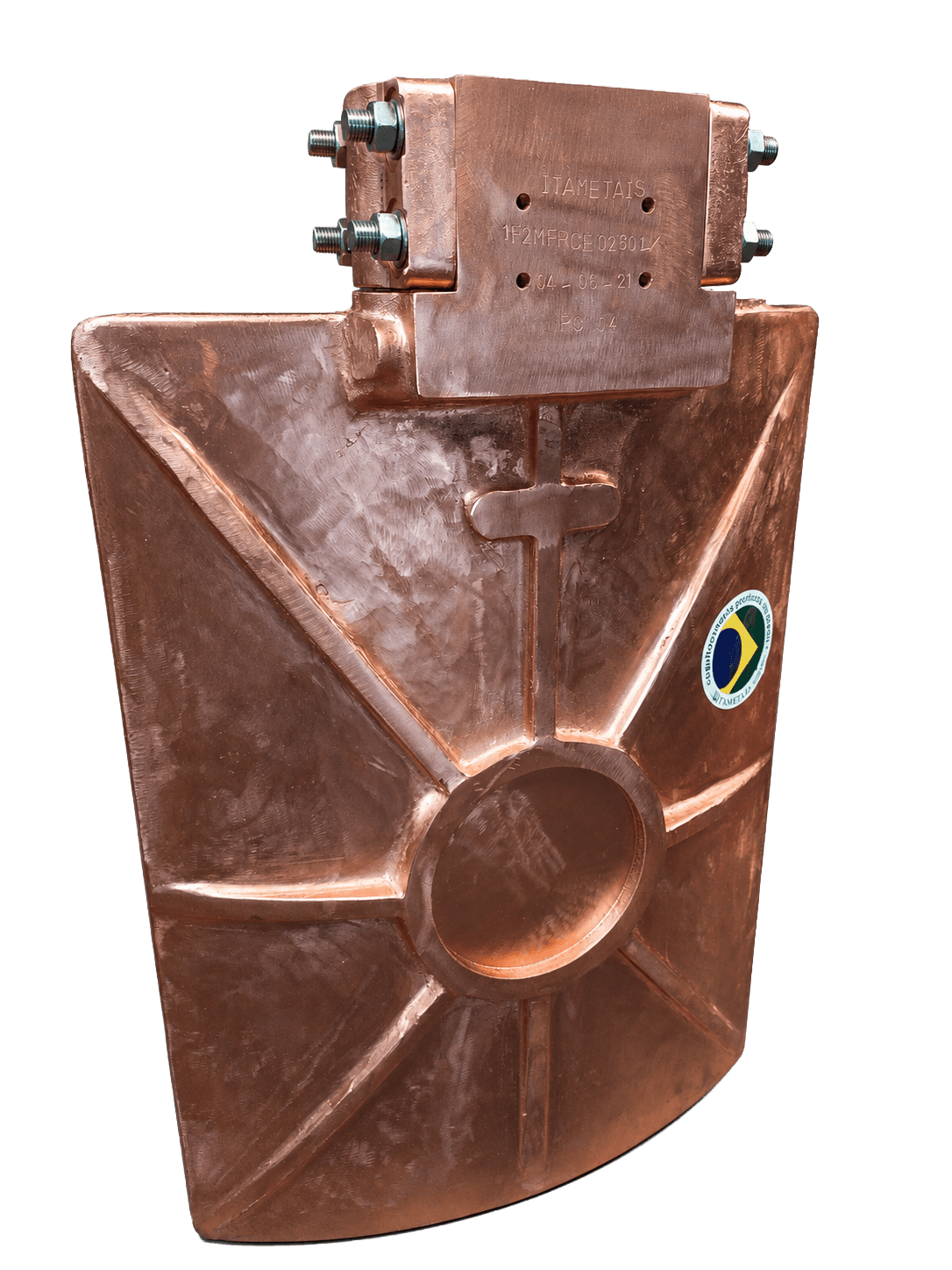
Contact plates are critical-duty conductive components that establish the electrical interface between the power-supply system and electric-furnace electrodes. In Söderberg systems, the plates are positioned around the electrode and held under pressure to transfer current; in other configurations, they form part of the electrode-holder assembly and contact graphite electrodes.
 01 / 79
A correctly dimensioned contact surface promotes uniform current transfer and helps control electrical resistance at the electrode interface. Inadequate geometry, uneven wear, residue, insufficient cooling or poor contact may contribute to localized heating, electrical losses and abnormal discharges.
Manufacturing therefore requires control of the material, curvature, grooves, finish, cooling channels and mounting interfaces. Copper’s electrical and thermal conductivity, contact pressure, circuit integrity and dimensional accuracy must be considered together. When specified, the surface may be silver-plated or receive conductive silver, as well as other treatments developed for the equipment’s operating conditions.
Each furnace has its own current, electrode type and diameter, pressure system, temperature, cooling and operating-regime conditions. Itametais performs thermal, fluid-flow and electrical simulations to assess the main factors of the assembly:
These analyses support the development of new components and the improvement of contact plates already used by the customer.
Itametais manufactures high-conductivity copper contact plates from drawings, specifications or technical samples. Construction is defined from the equipment, material, geometry and operating conditions.
These features are not necessarily combined in a single plate. The configuration depends on the specification, furnace and electrode type, operating conditions and design compatibility.
In addition to manufacturing new components, Itametais performs reverse engineering, restoration of used plates, rebuilding of contact surfaces, and modifications or improvements to the cooling circuit. The technical assessment considers the material condition, geometry, wear, channel integrity and compatibility with the equipment. The feasibility and scope of restoration are defined only after this assessment. Not every used component is technically suitable for restoration.
Contact-plate reliability depends on copper quality, cooling-circuit integrity and the accuracy of functional surfaces. Itametais quality control includes:
These inspections and tests make it possible to assess the material, internal channels, joints, leak tightness, critical dimensions and the electrical performance expected for the application.
When the material, geometry, cooling and surfaces are specified for the application, the assembly can contribute to the system’s electrical and thermal performance. Results also depend on installation, operating regime and equipment maintenance.
Continue exploring
Assemblies manufactured to the supplied configuration and design.
View product →Non-ferrous components developed for critical industrial applications.
View product →Machined components manufactured to project dimensions and requirements.
View product →Alloy selection cannot be separated from the application. Understand how function, manufacturing and the operating environment guide this decision.
Read article →Technical assessment
Send us the drawing, sample or equipment data. Our team can assess the material, contact surface, cooling circuit and electrical requirements of the application. To support the assessment, include, when available, the furnace type, electrode type and diameter, material, electrical and operating conditions, and required quantity.