Copper, bronze and aluminum: how material selection shapes a project
Alloy selection cannot be separated from the application. Understand how function, manufacturing and the operating environment guide this decision.
Read article →Anti-friction and wear
Components manufactured to drawing for industrial applications that require load capacity, dimensional stability and reliable performance in rotary, oscillating or sliding motion.
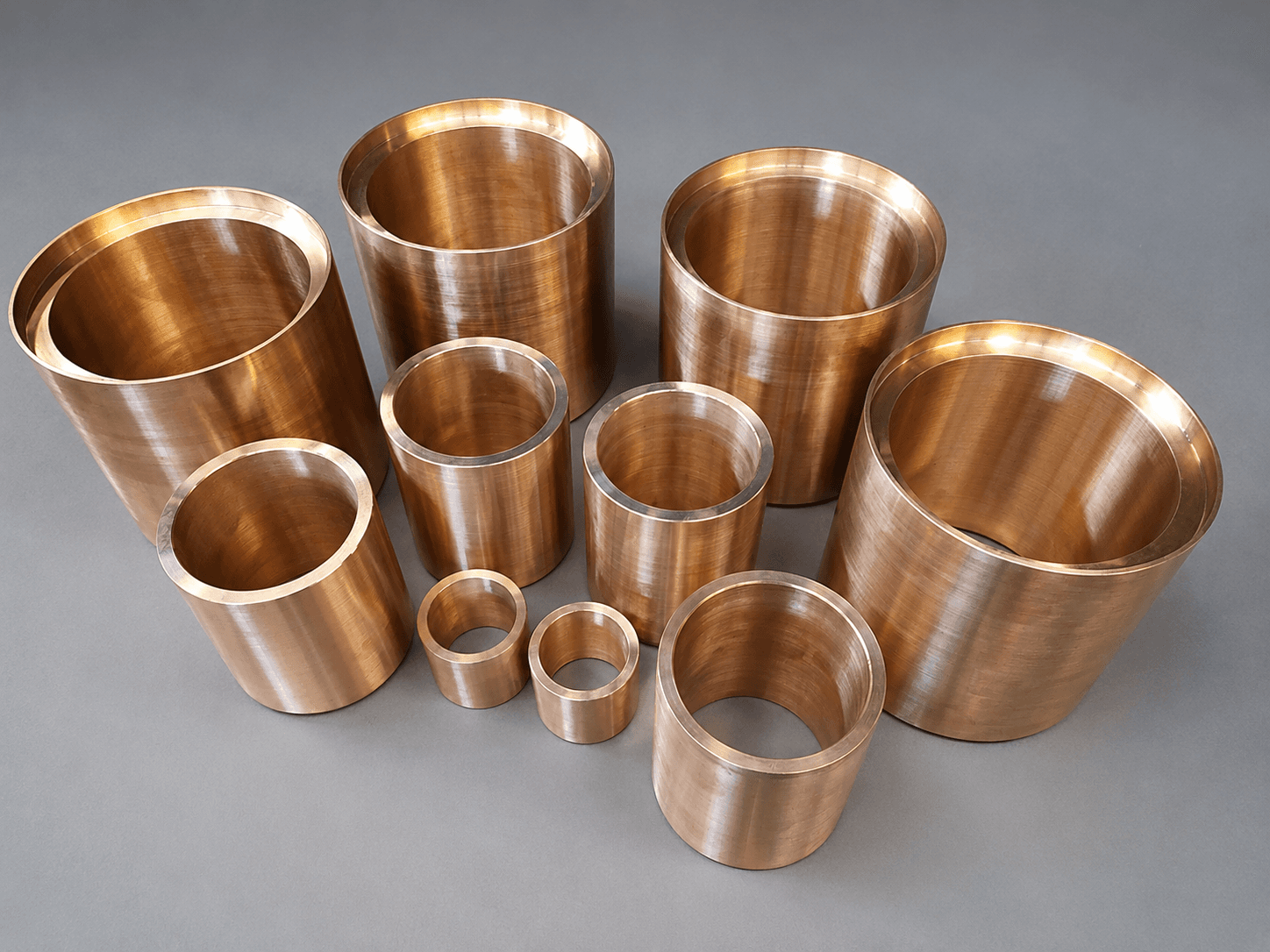
Itametais manufactures bronze bushings and bearings in different alloys, geometries and supply conditions. Alloy selection, casting process, machining, finishing and lubrication system are defined according to the drawing and operating conditions of each application, including large components weighing up to 1,500 kg per part, subject to technical feasibility assessment.
 01 / 89
Bronze bushings, plain bearings and sliding components are manufactured from technical drawings, samples, customer specifications and operating data. Dimensions, tolerances, mounting, lubrication and finish form part of each component’s technical definition.
The specification may consider load, speed, type of movement, temperature, duty cycle, environment, shaft, housing, clearances and interference fits. Assessing these factors together can support dimensional stability, mounting compatibility and performance suited to the application.
A bushing is the sliding component installed between moving surfaces; a plain-bearing assembly may comprise a broader support system with a housing and solid, split or segmented elements. This distinction guides drawing review and the definition of the supply scope.
Load capacity and direction depend on geometry, sizing and operating conditions. A given configuration is not automatically suitable for both radial and axial loads.
Itametais manufactures components in the bronze alloys specified for the project, including SAE 67, SAE 68, SAE 430 and other SAE, ASTM or equivalent alloys defined by the application or customer.
Alloy selection considers the component’s mechanical and dimensional requirements and its interaction with the equipment.
No alloy is universally superior. Selection depends on the combination of application requirements and the approved specification.
The manufacturing process is selected according to alloy, geometry, dimensions, mass, quantity, tolerances and functional requirements. The choice is made for the specific project without treating any process as a universal solution.
Supply condition and lubrication features are defined by the drawing and specification. Components can be delivered at different manufacturing stages to suit the customer’s production and assembly process.
The technical team can support component definition and improvement using the available information, always subject to technical assessment and customer approval before any design change.
The inspection plan is defined according to applicability, project specification and customer requirements. Available controls include:
Applicable tests and documents depend on the product and contracted requirements; they are not necessarily performed for every component.
Itametais has the capacity to manufacture bronze bushings and bearings weighing up to 1,500 kg per part for large industrial equipment and applications subject to severe operating conditions.
Feasibility depends on geometry, alloy, tolerances, manufacturing process and the other drawing requirements. Each component undergoes technical review before supply is confirmed.
Bushings and bearings can be developed for shafts, joints, crushers, presses, rolling mills, conveyors, gearboxes, material-handling equipment, process machinery and other systems subject to high loads, shock or oscillating motion. Each component is sized for its specific application.
Component behavior results from the combination of design, material, equipment, installation and maintenance. Technical assessment should consider:
Correct specification of these factors contributes to compatibility and expected performance while preserving the need for proper installation, lubrication and maintenance.
Continue exploring
Alloy selection cannot be separated from the application. Understand how function, manufacturing and the operating environment guide this decision.
Read article →Technical assessment
Send us the drawing, dimensions, specified alloy or application data. Our technical team will assess the manufacturing process, supply condition and controls required for the project.