Contact plates
Copper components manufactured to drawing for industrial systems.
View product →Electrical and thermal conduction
Made-to-drawing components for high-current conduction in industrial equipment, considering current, heating, movement, cooling, mounting and environmental conditions.
Itametais manufactures rigid and flexible copper connectors, assemblies with stranded conductors, and cast or forged terminals. Solutions are defined for the electrical, thermal, mechanical and dimensional requirements of each application, including special copper terminals weighing up to 1,500 kg per unit, subject to technical feasibility assessment.
 01 / 08
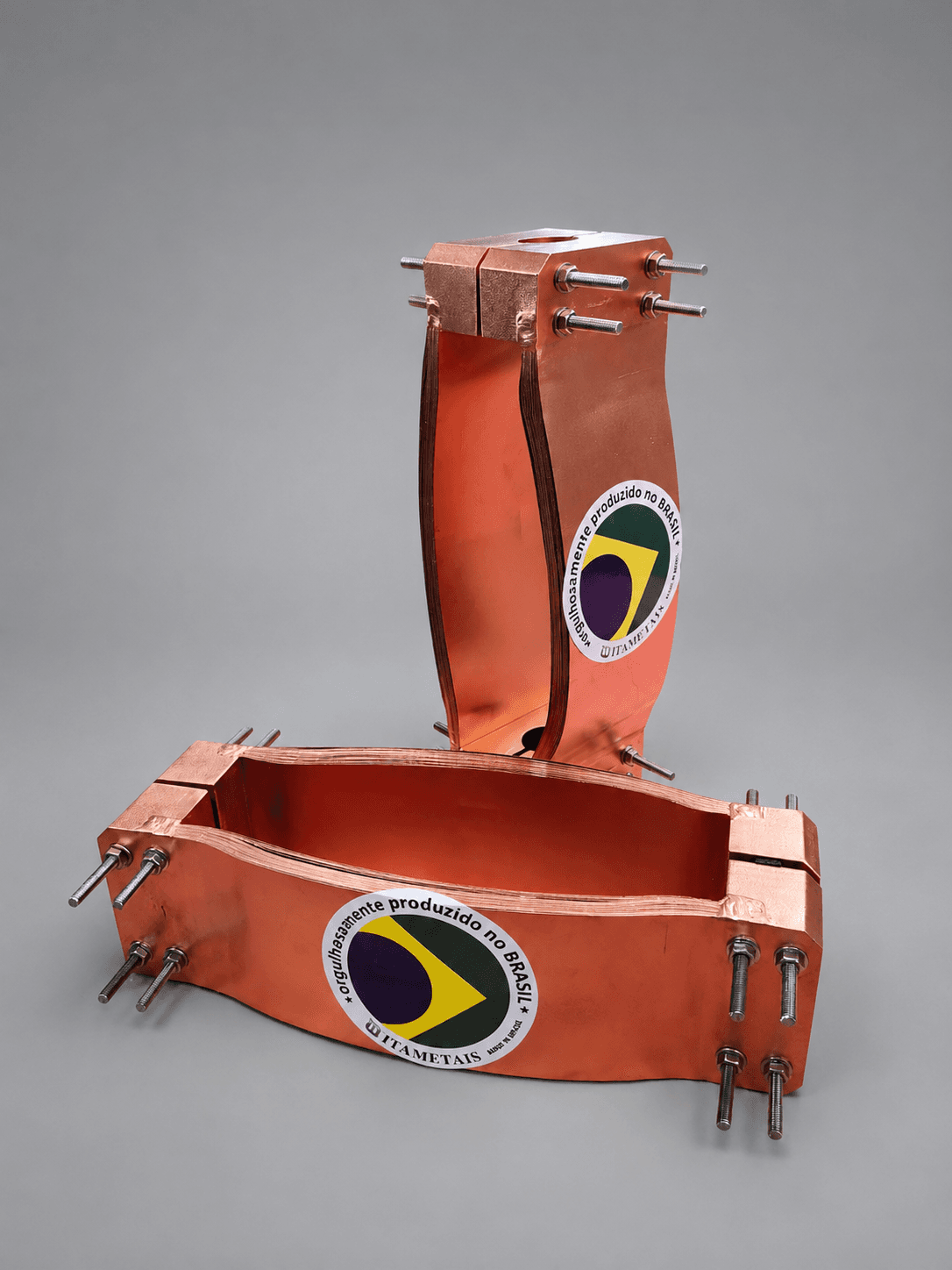
A stranded copper conductor is a flexible element made from multiple copper wires gathered and stranded together. A copper braid uses interwoven wires, usually in a flat or tubular construction, while a laminated connector combines stacked copper sheets or foils.
A copper terminal provides the electrical and mechanical interface with busbars, transformers, electrode arms or other equipment. A connector is the rigid or flexible assembly that links electrical components; a complete flexible connector may combine one or more conductors, terminals, insulation, hoses, fittings and protective coverings.
High-current connectors can link transformers, busbars, electrode arms and holders, rectifiers, welding equipment, power systems and industrial machinery.
In flexible assemblies, the construction may accommodate intended movement, thermal expansion and vibration, reduce forces transferred to rigid connections and adapt to the equipment geometry. These effects depend on sizing, actual movement and installation.
Configuration is defined according to current, duty cycle, required flexibility, movement, available space, temperature, cooling, environment and mounting interface. The alternatives are not automatically suited to the same conditions.
According to the specification, Itametais works with electrolytic copper, Cu-ETP, oxygen-free copper and special copper alloys. Conductors may be bare or tin-plated; conductors and surfaces may receive a silver coating when technically applicable.
Tin and silver are treated as surface coatings rather than independent alloys. Selection considers electrical conductivity, mechanical strength, temperature, joining process, environment, oxidation, contact area, surface protection and compatibility with connected components.
The terminal forms part of the current path and also transfers loads to the assembly. Its design may consider contact area, current distribution, hole pattern, geometry, thickness, mechanical strength, surface finish, conductor joint, fastening and, when applicable, water inlet and outlet.
Itametais manufactures cast copper terminals and forged copper terminals to drawings or samples, including special geometries and hole patterns, with machining and finishing to specification.
Itametais can manufacture copper terminals weighing up to 1,500 kg per unit. This capacity applies specifically to the terminal, not to the stranded conductor or the total weight of a complete connector.
Feasibility depends on geometry, material, manufacturing process, machining, tolerances and the project’s technical requirements.
Itametais purchases the copper braids or flexible conductors according to the project specification, then manufactures and assembles the complete connector. The work is more than resale of a finished assembly and does not imply that Itametais makes the individual wires or produces the braid from raw material.
Terminals and conductors may be joined by pressing or compression, welding, brazing, metal filling or consolidation, or a combination of processes when technically applicable.
Selection considers material, electrical cross-section, geometry, current, temperature, flexibility, mechanical loads, cooling, environment and customer requirements. No process is universally superior to the others.
Water-cooled assemblies may incorporate terminals with internal channels, flow passages, water inlet and outlet, hoses, fittings, rotary joints, thermal or abrasion protection, and conductors arranged to the drawing or sample.
Design must consider water flow, pressure, temperature and quality, flow distribution, pressure loss, sealing, channel geometry, movement, torsion, radiant heat, abrasion and possible blockage. Cooling does not remove the need for correct sizing, inspection and maintenance.
Assemblies may also dissipate heat without an internal water circuit and are sized according to current, conductor cross-section, duty cycle and heat-dissipation conditions. The application may use air cooling when expressly included in the design.
Connectors may be insulated or non-insulated and may receive protection against abrasion, radiant heat or metal spatter for demanding industrial environments.
Insulation and protection materials are defined according to application conditions and customer requirements, without assuming a universal rating or temperature limit.
Technical support may start from a drawing, sample or application data. Any resizing or improvement is subject to technical assessment and customer approval.
Assembly behavior depends on the combination of electrical, thermal, mechanical and environmental requirements. Assessment may consider:
Cross-section and operating limits must be sized for the project; a generic current density does not apply to every configuration.
According to applicability, technical specification and contracted requirements, the inspection plan may include:
Controls vary with the product and contract. Hydraulic tests are not presented as mandatory for connectors without a water circuit.
More than 200 connectors have been supplied for industrial applications, with configurations developed to drawings, samples and specific operating requirements. This experience does not replace assessment of each new project or constitute a performance guarantee.
Itametais also assesses used connectors. Recovery depends on technical inspection and the condition of each assembly.
Sizing, installation, environment and maintenance influence assembly reliability. Factors requiring attention include:
When correctly sized, copper connectors may support high-current conduction, accommodate movement and thermal expansion, reduce forces transferred to rigid components and match the equipment geometry.
Made-to-drawing engineering also allows cooling, special terminals, assembly recovery, environmental protection and electrical and dimensional controls to be assessed. Results depend on operating conditions and technical evaluation.
Each connector must be specified for its application and duty. Solutions may be assessed for the following industries and equipment:
Continue exploring
Copper components manufactured to drawing for industrial systems.
View product →Casting, machining, finishing and inspection belong to the same chain of decisions. Understand the logic that connects these stages.
Read article →Technical assessment
Send us the drawing, sample and the application’s electrical, thermal and mechanical data. Our team can assess the conductor, terminals, joining process, cooling and protective features required.